
Common Daikin AC Error Codes (With Solution)
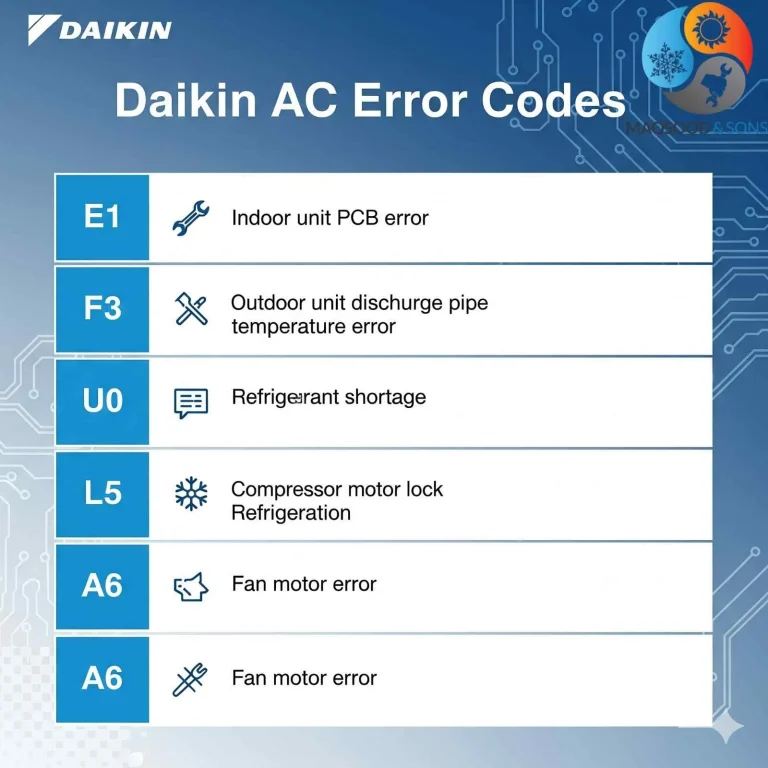
Daikin air conditioners are known for their durability and efficiency. However, like any advanced HVAC system, they occasionally run into issues. Thankfully, Daikin units come with a self-diagnosis system that displays error codes, helping users and technicians quickly identify and solve problems. Understanding these codes can save time, reduce repair costs, and keep your AC running smoothly.
Why Error Codes Matter For Your Daikin AC
Early detection: Prevents small issues from becoming major breakdowns.
Cost-saving: Quick diagnosis reduces unnecessary technician visits.
User-friendly: Many issues can be resolved with simple fixes like cleaning filters or checking wiring.
Know These Daikin AC Errors Codes And Fix Your AC At Home ✅
Indoor Unit Errors (A / C series)
| Code | Error | Common Causes |
|---|---|---|
| A1 | Indoor unit PCB malfunction | Faulty PCB, external noise |
| A3 | Drain Level Control abnormality | Clogged drain, defective pump/sensor |
| A4 | Freezing protection malfunction | Low water temp, defective thermistor |
| A5 | High pressure / freeze-up protection | Clogged air filter, faulty thermistor |
| A6 | Fan motor malfunction | Broken wiring, faulty motor/PCB |
| A7 | Swing flap motor malfunction | Defective motor, PCB, or flap |
| A8 | Power supply / AC input overcurrent | Faulty wiring or power supply |
| A9 | Electronic expansion valve malfunction | Faulty valve coil, PCB, or relay cables |
| C4 | Liquid pipe thermistor fault | Defective thermistor/PCB |
| C9 | Suction air thermistor malfunction | Faulty thermistor or PCB |
Outdoor Unit Errors (E / F / H / J / L / P series)
| Code | Error | Common Causes |
|---|---|---|
| E1 | Outdoor unit PCB defect | Faulty PCB, relay wiring issues |
| E3 | High pressure switch actuation (HPS) | Dirty heat exchanger, clogged piping |
| E4 | Low pressure switch actuation (LPS) | Low refrigerant, faulty sensor/PCB |
| E5 | Inverter compressor motor overheat | PCB failure, wiring error, high pressure |
| E6 | STD compressor motor overcurrent | Faulty compressor, closed valve |
| E7 | Outdoor fan motor malfunction | Motor failure, blocked fan, wiring issue |
| E8 | Inverter compressor overcurrent | PCB or transistor failure |
| F3 | Discharge pipe temperature error | Faulty thermistor, abnormal temp |
| H3 | High pressure switch malfunction | Faulty switch, wiring, PCB |
| J3 | Discharge pipe thermistor fault | Thermistor or PCB defect |
System / Communication Errors(U / M series)
| Code | Error | Common Causes |
|---|---|---|
| U0 | Shortage of refrigerant | Leak, clogged piping, sensor issue |
| U1 | Reverse / Open phase | Power supply issue |
| U2 | Power supply failure | Abnormal voltage, power drop |
| U3 | Check not executed / transmission error | Setup not completed |
| U4 | Indoor–Outdoor transmission error | Wrong wiring, PCB defect |
| U5 | Indoor–Remote controller transmission error | PCB failure, wiring, noise |
| U6 | Indoor–Indoor transmission error | Faulty wiring, PCB issue |
| U7 | Outdoor–Outdoor transmission error | Wiring/connection error |
| UC | Central control address setting error | Duplicated address |
| UH | General system malfunction | Indoor/outdoor PCB issue |
Common Indoor Unit Issues
A1 – Indoor PCB Malfunction → Usually requires PCB replacement.
A3 – Drain Clog → Clean drain lines/pump.
A4 – Freezing Protection → Ensure water volume & thermistor health.
A6 – Fan Motor Malfunction → Check motor wiring or replace motor.
Tip: Regular cleaning of filters and drains prevents 70% of indoor errors.
Common Outdoor Unit Issues
E3/E4 – High & Low Pressure Switch Errors → Check refrigerant levels and clean condensers.
E5/E6 – Compressor Overload → Ensure proper ventilation and wiring.
E7 – Fan Motor Fault → Remove obstructions, check wiring.
F3 – Discharge Pipe Temp Error → Check thermistors and refrigerant cycle.
Tip: Outdoor units must have proper airflow – avoid blockage by debris or plants.
Common System Errors
U0 – Refrigerant Shortage → Leak detection & recharge.
U1 – Power Supply Issue → Check phases & voltage.
U4/U5 – Communication Errors → Verify correct wiring and PCB health.
Tip: During installation, double-check wiring & address settings to avoid transmission errors.
5 Simple Maintenance Tips for Daikin AC
Clean filters every 2–4 weeks.
Inspect drain lines to prevent clogs.
Ensure outdoor unit clearance (at least 2 feet).
Check power supply stability (use stabilizers in unstable areas).
Schedule annual servicing for refrigerant and compressor health.