
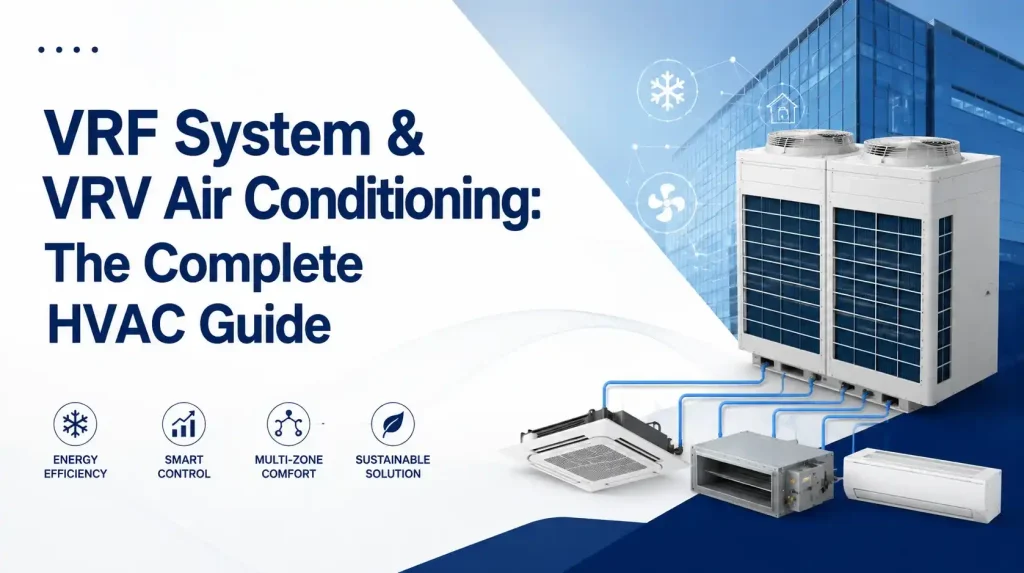
VRF System & VRV Air Conditioning: The Complete HVAC Guide
Ever walked into an office building where the meeting room feels like a walk-in freezer while the reception area next door is uncomfortably warm? Or maybe you’ve managed a villa where the guest room sits empty all day, quietly burning electricity because the AC has no idea nobody’s in there.
Yeah. We hear about this a lot.
Most buildings don’t need the same amount of cooling everywhere, all the time. A hotel has rooms filling and emptying by the hour. An office has meeting rooms that get used for two hours and then sit dark. A villa might only need serious cooling in two or three rooms come evening. But a lot of conventional AC setups just… don’t care. They cool the whole building like it’s one big room, whether anyone’s in it or not.
That’s the gap a VRF system is actually built to close.And at Maqsood & Sons, this is a conversation we have with clients constantly
VRF — short for Variable Refrigerant Flow — is a VRF HVAC setup where one outdoor unit talks to several indoor units at once, and each of those indoor units gets to do its own thing. It’s become the go-to choice for offices, hotels, hospitals, malls, and larger homes where a basic split AC setup starts to feel like putting a band-aid on a bigger problem.
So let’s actually get into it, what VRF is, how it’s different from VRV (spoiler: not by much), and whether it makes sense for your building.
What Is Actually a VRF System?
VRF stands for Variable Refrigerant Flow, and honestly, the name tells you most of what you need to know once you unpack it a little. It’s a system that adjusts how much refrigerant flows through it based on what each room is actually asking for at that moment.
A typical VRF air conditioning system has one outdoor unit connected to multiple indoor units — sometimes a handful, sometimes dozens on a large commercial job. Each indoor unit handles its own room or zone. So instead of one thermostat deciding the fate of an entire floor, every space gets a say.
Here’s the part that actually matters day-to-day: a conventional AC compressor is pretty much a light switch. On or off. Full blast or nothing. A VRF AC system, with its inverter-driven compressor, works more like a dimmer switch — it eases up or down depending on the load, instead of slamming on and shutting off over and over. That’s a big deal for both comfort and your electricity bill.
What Does VRF Mean in HVAC?
If you want the short version — the actual VRF meaning — it’s this: the system varies how much refrigerant it sends around, based on real-time demand from each connected indoor unit.
So next time someone asks “what is VRF” or “what is a VRF system,” you can skip the textbook definition and just say:
It's a multi-zone air conditioning system that adjusts refrigerant flow so different rooms can be cooled or heated independently — and efficiently.
VRV vs VRF: What's the Difference?
This one trips people up constantly, and honestly, it’s a smaller deal than it sounds.
VRV stands for Variable Refrigerant Volume, and it’s a name tied specifically to Daikin. Other manufacturers — Mitsubishi, Gree, LG, take your pick — use VRF, Variable Refrigerant Flow, to describe basically the same idea: one outdoor system, multiple indoor units, refrigerant flow controlled to match demand.
So when you’re comparing VRV vs VRF, you’re not really comparing two different technologies. You’re mostly comparing two different labels for the same category of system, plus whatever specific engineering choices each manufacturer happens to make.
You’ll run into a bunch of related terms floating around too:
- VRV system HVAC
- VRV AC
- VRV air conditioning
- VRV aircon system
- VRV AC system
- VRV air conditioning system
None of them change the fundamentals. What actually matters — and this is the part people skip past — is the capacity, the design, the controls, how well it’s installed, how efficient it actually runs, and whether the brand has decent service support near you. That’s where projects succeed or fail. Not in the VRV-versus-VRF debate.
Why Use a VRF System?
Okay, so why do people actually go through the trouble of installing one of these? A few reasons, and they add up.
1- Independent zoning
Every indoor unit can run its own show. That meeting room can freeze while the empty storage room three doors down stays exactly where it is — unpowered, or close to it. You’re not paying to cool space nobody’s using.
2- Efficient operation
Because the compressor adjusts itself instead of cycling fully on and off, a VRF system HVAC setup can run efficiently even when half the building is empty — which, let’s be honest, describes most office buildings most of the day.
3- Flexible indoor unit options
Wall-mounted, ceiling cassette, concealed ducted — you’re not locked into one look or layout. That flexibility matters more than people expect once they see how different rooms in the same building can need completely different solutions.
4- Lower visual impact
One outdoor system serving a dozen indoor units means you’re not staring at a wall covered in outdoor condensers. Anyone who’s tried to design a clean building exterior around six separate split units knows exactly why this matters.
5- Suitable for multi-zone buildings
If your building has rooms with genuinely different needs — sun-facing offices that run hot, interior rooms that don’t — VRF technology is built for exactly that kind of variation.
5- Inspect the Drain Pipe
Check the plastic tube that carries water outside. Remove any sludge or dirt blocking the flow. A clear pipe prevents water from leaking inside the room. Brands with shallow drain pans, like certain LG models, require a completely clear path to avoid immediate overflow.
Advantages and Disadvantages of VRF Systems
Nothing’s perfect, and VRF isn’t an exception. The right call depends on your building, your budget, and honestly, how patient you are with the installation process.
Advantages | Limitations |
Independent zone control | Higher upfront cost than basic split AC |
Efficient operation under varying loads | Needs experienced design and installation — not a corner-cutting job |
Flexible indoor unit configurations | Refrigerant piping has to be done right, or you’ll pay for it later |
Suitable for many commercial applications | Diagnosis and repair can need specialist knowledge |
Less dependence on large duct networks | Not ideal for every ventilation or high-air-change need |
Modular system design | Poor installation shows up as reliability problems down the line |
If there’s one thing to take from that table, it’s this: VRF rewards good installation and punishes bad installation more than most systems do. The piping, the brazing, the commissioning — none of it is a place to save a few rupees by hiring whoever’s cheapest, which is exactly why Maqsood & Sons treats installation as seriously as we do.
Where Are VRF Systems Used?
The honest answer is “wherever a building has different rooms with different needs.” A few places we see it come up again and again:
Homes and villas
A VRF system for home use makes the most sense in a larger villa — the kind with several living areas that each need their own comfort settings, rather than one AC unit fighting to serve the whole house.
Offices
A commercial VRF system handles the reality of office life pretty well: cabins, meeting rooms, reception, open floor space — all with different occupancy patterns, all getting their own control.
Hotels
Hotels are basically a textbook use case. Rooms fill and empty constantly, and every guest expects to set their own temperature without caring what the room next door is doing.
Hospitals and clinics
Healthcare spaces need steady, dependable temperature control — though it’s worth saying the HVAC design here also has to account for ventilation requirements beyond just cooling, so it’s rarely a simple VRF-only decision.
Shopping malls and retail spaces
Smaller retail units, back offices, and common areas all benefit from individual control instead of one system trying to please everyone at once.
VRF System Types & Configurations
There’s no single “one-size-fits-all” VRF unit setup. What you install depends heavily on the building and what you actually need it to do.
VRF Heat Pump Systems
A VRF heat pump system generally runs in either cooling mode or heating mode across the connected zones, depending on how it’s configured.
Heat Recovery VRF Systems
Heat recovery systems can do both at once — cooling one zone while heating another. That’s genuinely useful in buildings where, say, the sun-facing side runs warm while the shaded side needs a bit of heat, especially during shoulder seasons.
Three-Pipe VRF Systems
A 3 pipe VRF system is the piping arrangement typically used for heat-recovery operation. Exactly how it’s configured comes down to the manufacturer and the overall system design.
Ductless VRF
A ductless VRF setup relies on units like wall-mounted or ceiling cassette models, skipping the whole conventional duct network. Less construction mess, faster installation in a lot of cases.
Ceiling Cassette VRF
A ceiling cassette VRF unit sits up in the ceiling and spreads air evenly across the room. You’ll see this constantly in offices and retail interiors — it’s discreet, and it doesn’t eat into wall space or floor space.
Concealed VRF Units
A concealed VRF unit hides above a false ceiling, connected to grilles or short duct runs. Good option when someone really doesn’t want to see the equipment at all.
VRF Multi-Split Systems
A VRF multi split system ties multiple indoor units back to one shared outdoor unit, which is really what gives you all this zoning flexibility in the first place.
VRF System and Indoor Unit Selection
Here’s something people underestimate — the indoor unit choice matters almost as much as the system itself.
Depending on the space, you might end up with:
- Wall-mounted indoor units
- Ceiling cassette units
- Concealed ducted units
- Floor-standing units
- Other manufacturer-specific configurations
What’s right for one room might be completely wrong for the next. Room size, ceiling height, how the airflow needs to move, what the architecture allows, how the space actually gets used day to day — all of it plays into the decision. This isn’t a “pick whatever’s available” situation.
VRF System in Pakistan
A VRF system in Pakistan needs to be designed around Pakistani conditions — not just dropped in from a spec sheet written somewhere with a mild climate and stable power.
Outdoor temperatures, the local electrical supply situation (we all know how that goes some days), building usage patterns, operating schedules — all of it changes how a system should be sized and installed. A system that looks great on paper can still underperform badly if it wasn’t actually designed for the site it’s sitting on.
For any larger project, we’re looking at things like:
- Outdoor design temperature
- Cooling load
- Electrical supply
- Backup power availability
- Building occupancy patterns
- Indoor unit selection
- Refrigerant piping layout
- Maintenance access
For Islamabad, Rawalpindi, and the surrounding areas specifically, local site conditions really do need a proper review before anyone commits to a final VRF configuration. Skipping that step is how you end up with an undersized system fighting a losing battle every June.
VRF System Applications: When Is It a Good Choice?
VRF tends to make sense when a building has:
- Multiple rooms or zones with different needs
- Occupancy that changes throughout the day
- A real need for independent temperature control
- Limited space for traditional ductwork
- A preference for flexible indoor unit placement
- A commercial setup, or a higher-end residential one
That said — and this matters — VRF isn’t automatically the right answer for every large building. Depending on size and use, a chiller-based system or another centralized approach might genuinely be the smarter call. We’d rather tell you that upfront than sell you a VRF system that’s the wrong fit.
VRF System Cost, Installation and Service
What actually drives VRF system cost
There’s no single number here, no matter how many times someone asks for “just a rough price.” Real project cost depends on:
- Total cooling capacity
- Number and type of indoor units
- Refrigerant piping length
- Building layout
- Controls
- Selected brand
- Installation requirements
- Commissioning
- Electrical work
- Site access and conditions
A generic VRF price or a per-ton figure thrown around online isn’t a real quote — it’s a starting point for a conversation, at best. The only way to get a number that actually means something is a proper site assessment, a calculated capacity requirement, and a project-specific quotation.
VRF Installation
This is where a lot of systems either earn their reputation or ruin it. VRF installation involves refrigerant piping, brazing, pressure testing, evacuation, electrical work, controls, and commissioning — and every one of those steps needs to be done according to the manufacturer’s actual requirements, not just “close enough.”
Get it wrong, and you’re looking at refrigerant leaks, uneven cooling, control glitches, and service calls that shouldn’t have been necessary in the first place.
VRF Service and Maintenance
Regular VRF service is what catches small issues before they turn into big, expensive ones. Depending on the system, that might mean indoor-unit cleaning, outdoor-unit inspection, coil cleaning, checking drainage, electrical checks, control diagnostics, and keeping an eye on refrigerant levels.
Maqsood & Sons handles VRF installation, commissioning, maintenance, and repair across Islamabad and Rawalpindi. We work on both commercial and residential systems like offices, hospitals, hotels, villas, malls, and other multi-zone buildings.
Planning a VRF Project?
Picking a VRF system works a lot better when you start with the building itself, not with whatever's at the top of a product catalogue.
At Maqsood & Sons, we'll come look at your site, actually understand your cooling needs room by room, and help you figure out whether VRF is the right call — or whether something else makes more sense for what you're working with.
If you're planning VRF installation, system design, maintenance, repair, or any commercial HVAC work in Islamabad or Rawalpindi, get in touch and we'll set up a site assessment.
Book Your Service Now